
From First Article to Rate Production
Choosing a Precision Manufacturing Partner for Mission-Critical Programs
For defense, aerospace, space, and high-reliability industrial programs, supplier selection is not just a purchasing decision. It is a program-risk decision. The right partner must help engineering and sourcing teams move from NPI, prototype, and first article builds into repeatable production with speed, discipline, and control.
NPI Speed Only Matters if It Leads to Production Readiness
Speed is valuable when a program is under pressure, but speed by itself is not enough. A fast prototype can still create long-term risk if the supplier cannot support inspection, documentation, process repeatability, supplier controls, and the production cadence that follows.
That is why the better question is not simply, “Can this supplier make the part?” The better question is, “Can this supplier help us move from technical feasibility to qualified, repeatable production without forcing another supplier handoff?”
In complex machining work, that handoff is where many programs lose time. A prototype supplier may be able to produce a small quantity quickly, but struggle with first article documentation, capacity planning, outside processing, inspection throughput, or multi-operation repeatability. When that happens, the customer often has to restart the qualification process with a different supplier just as the program should be moving faster.
The Supplier Handoff That Should Not Happen
A strong NPI-to-production partner helps reduce that handoff by bringing manufacturing planning, engineering review, quality planning, and production capacity into the conversation early. That means reviewing manufacturability before the first build, identifying cost and lead-time drivers, validating material and outside-processing assumptions, and building a path from first article to repeat production before the program is already behind schedule.
For mission-critical components, this matters because small misses can become large disruptions. A tolerance that looks manageable on a print can become a bottleneck if inspection is not planned correctly. A coating, plating, heat treat, or cleaning requirement can become the longest pole in the tent if the outside-processing path is not validated. A part that machines well one time can become difficult to scale if workholding, programming, CMM strategy, or operator handoff is not repeatable.
The strongest manufacturing partners treat NPI as a controlled launch process, not a one-time quote event. They ask the hard questions early, confirm the right manufacturing site, identify whether the work belongs in a quick-turn cell or a production cell, and build the first run with the next run in mind.
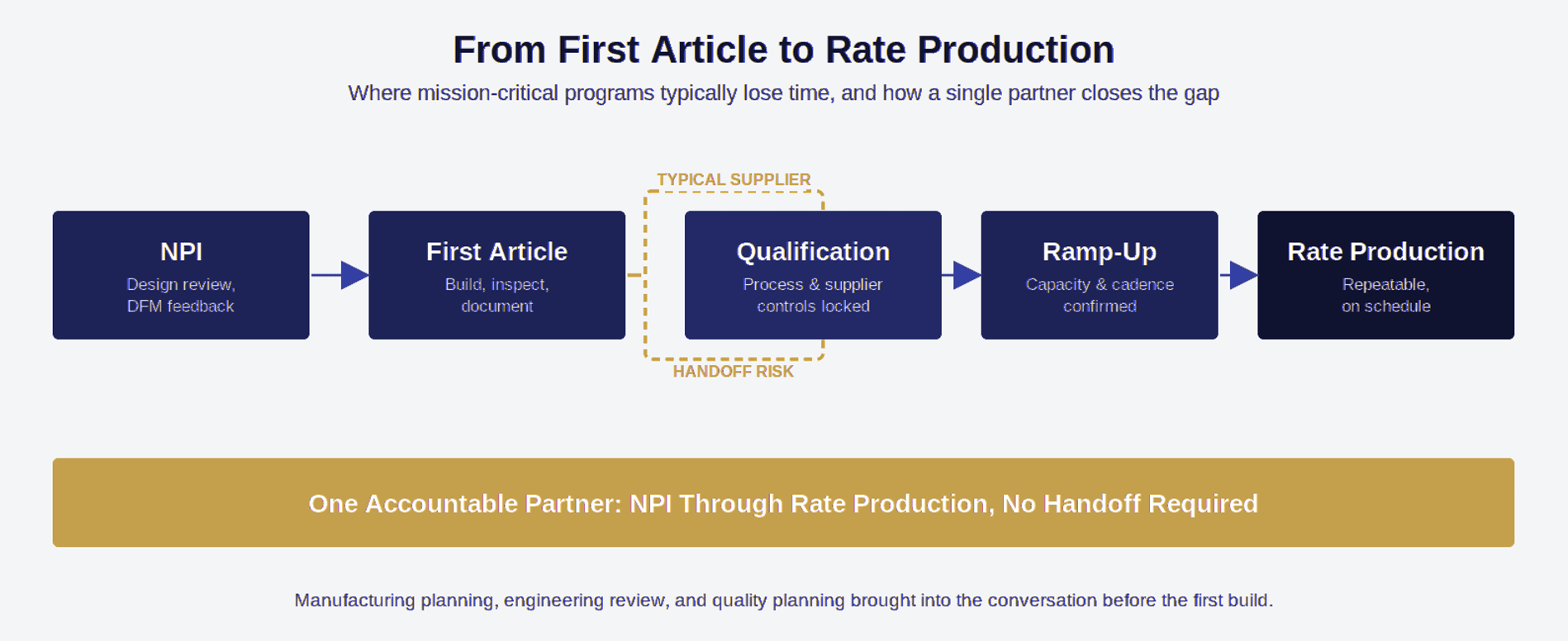
From First Article to Rate Production: where programs typically lose time, and how one accountable partner closes the gap.
Certification, Compliance, and Process Control Are the Baseline
For defense, aerospace, space, and other high-reliability work, quality credentials are not marketing language. They are the baseline required to protect the program. AS9100, ISO 9001, and ITAR controls help ensure that documentation, traceability, configuration management, and controlled technical data are handled with the discipline these programs require.
Prince Industries brings a multi-site manufacturing footprint with AS9100-certified facilities, ISO 9001 certification, ITAR registration, and experience supporting demanding aviation, aerospace, defense, space, medical, and high-reliability industrial applications. Those controls allow customers to move quickly without giving up the rigor required for regulated and mission-critical work.
The point is not certification alone. The point is what certification enables: controlled handoffs, repeatable processes, documented inspection requirements, disciplined corrective action, and a framework for moving from urgent development work into a stable production environment.
High-Tolerance Machining Requires More Than Machine Count
High-tolerance machining is not just about owning advanced equipment. It is about having the right mix of process knowledge, qualified capacity, inspection discipline, engineering support, and operational flexibility to support the full program lifecycle.
Prince supports this environment with more than 200 machining centers across 5-axis, 4-axis, and 3-axis platforms; mill/turn capability with twin-spindle and twin-turret platforms; EDM for challenging geometries and demanding materials; precision grinding and honing; robotic welding; sheet metal fabrication; assembly; testing; part marking; and long-bar horizontal milling up to 25 feet for near-net shapes and slugs.
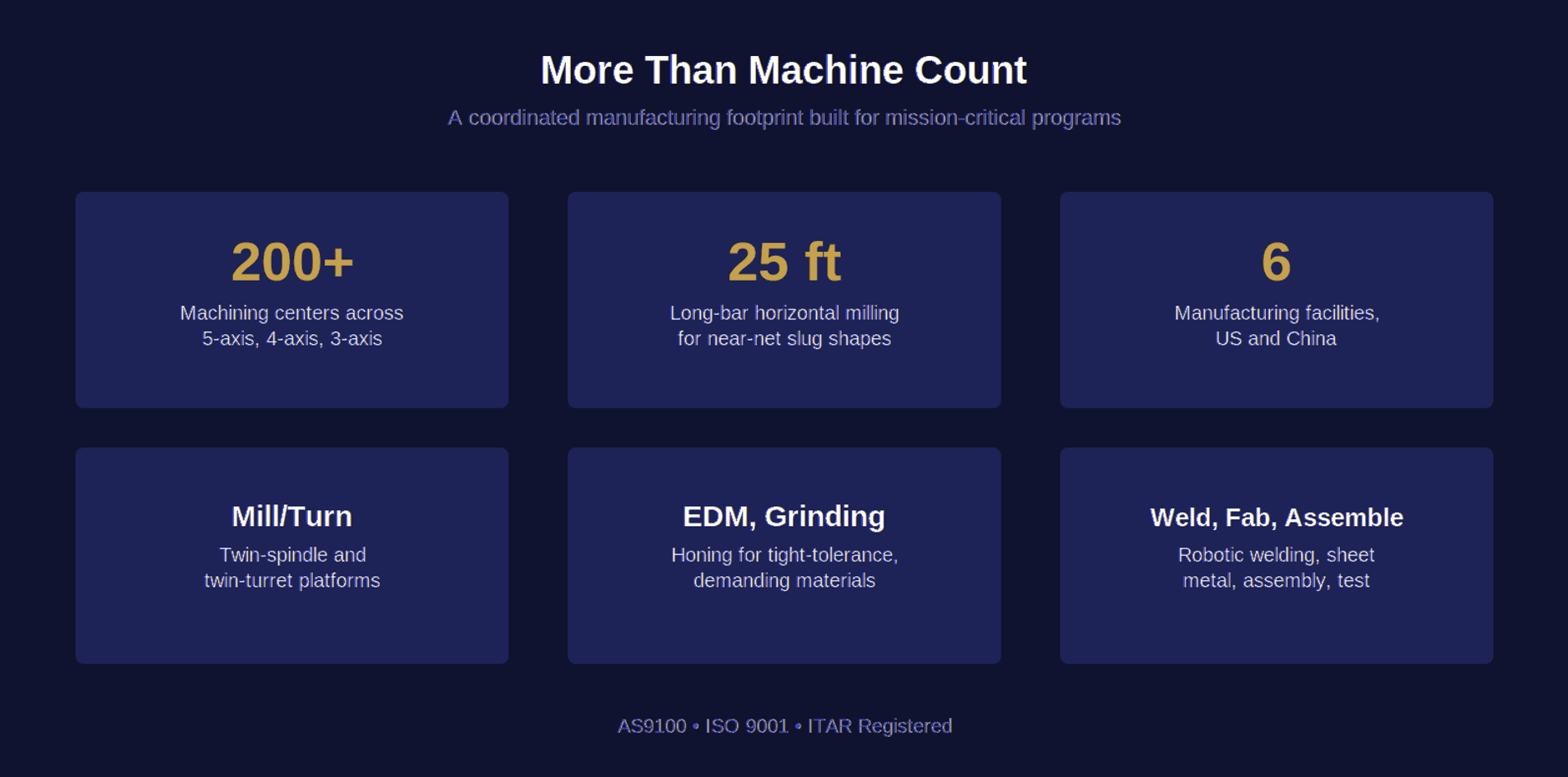
A coordinated manufacturing footprint built for mission-critical programs.
That breadth matters because difficult programs rarely fail at only one operation. They fail at the seams between operations: machining to outside processing, outside processing to inspection, inspection to assembly, assembly to documentation, and documentation to shipment. A broader, coordinated manufacturing partner can reduce those seams and create one accountable path through the work.
Long-Bar Milling and Other Specialized Capabilities Can Change the Manufacturing Path
Some programs require a manufacturing approach that conventional machining alone may not solve efficiently. Long-bar horizontal milling is one example. By machining bars up to 25 feet through a series of custom cutting dies, Prince can support near-net or finished slug shapes that may reduce downstream machining, improve control of intricate cross-sections, and offer an alternative to extrusion or drawing for the right applications.
That capability is most valuable when it is applied as part of an engineering and production conversation, not as a standalone process. The right question is whether the manufacturing path can reduce operations, simplify repeatability, improve throughput, or create a more cost-effective route to the final print requirement.
Rapid Response Should Be Structured, Not Heroic
Many suppliers can “rush” a job once. Fewer can build a repeatable rapid-response model that protects quality, margin, and customer trust. For high-visibility NPI and recovery work, urgency needs structure: clear intake requirements, fast technical review, early material and outside-processing validation, capacity confirmation, and disciplined customer communication.
Prince’s approach is built around moving quickly while still validating the fundamentals: fit to capability, technical risk, tolerances, inspection requirements, program visibility, compliance needs, and a realistic path to production. That is what separates speed from chaos.
This is also where a dedicated NPI or Special Operations-style support model can create value. When the work is high priority and time sensitive, customers need a team that can coordinate engineering, estimating, purchasing, quality, operations, and sales without letting the opportunity sit in a queue. The goal is not simply to submit a quote faster. The goal is to determine quickly whether the program is a fit, what risks need to be resolved, and how to launch the work without creating downstream problems.
Supplier Consolidation Is a Risk-Reduction Strategy
Managing five suppliers for one critical assembly can look flexible on paper, but it often increases execution risk. Every supplier handoff creates another communication point, another schedule dependency, another quality interface, and another opportunity for information to be lost.
For complex assemblies and multi-process components, Prince can support precision machining, sheet metal fabrication, welding, assembly, testing, and part marking through one accountable partner. That can reduce handoffs, improve responsiveness, and help customers move faster when dates change, quantities ramp, or engineering requirements evolve.
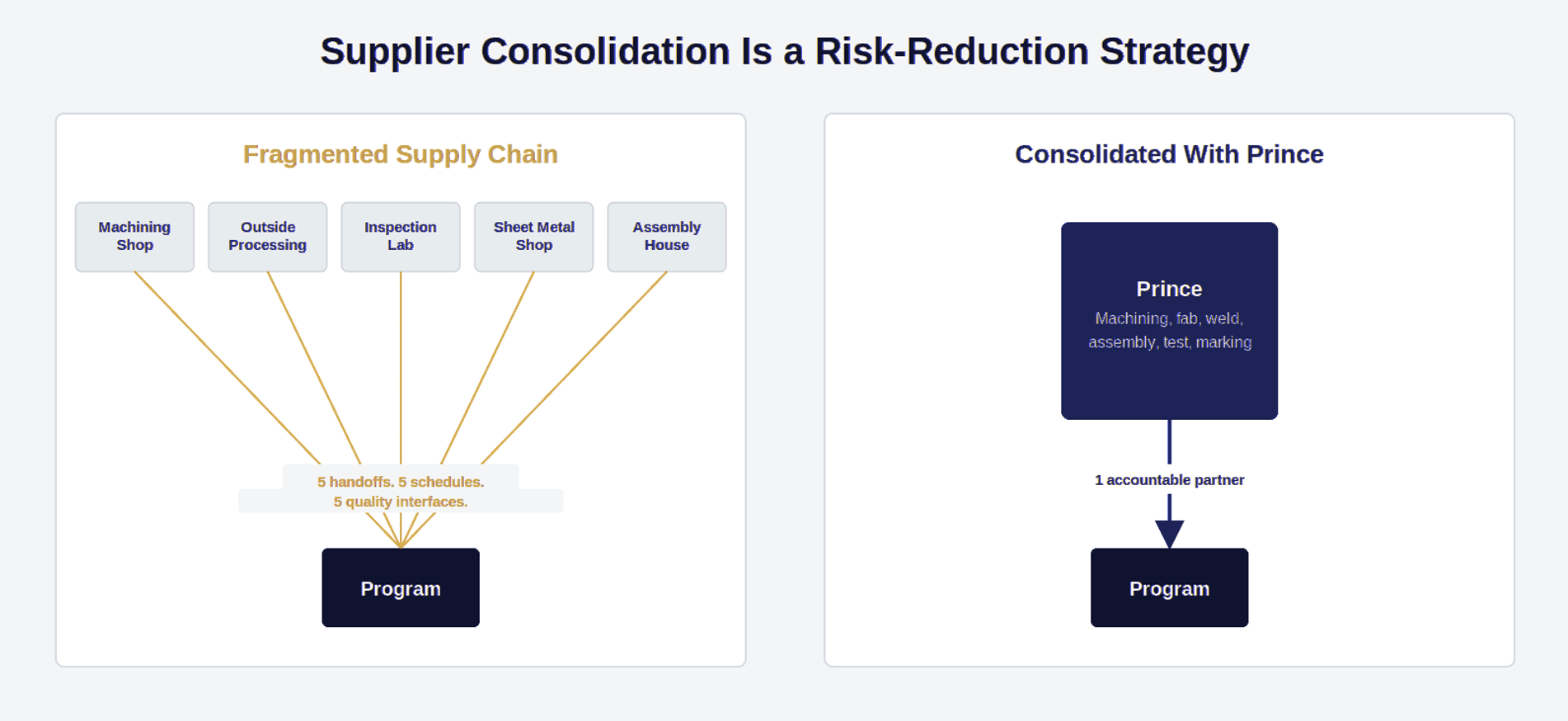
Every additional supplier handoff adds another communication point, schedule dependency, and quality interface.
Supplier consolidation is not about reducing choices for the sake of simplicity. It is about giving the customer clearer accountability when the program needs urgency, traceability, and coordinated execution.
Capacity Redundancy and Cross-Facility Support Matter as Programs Scale
Production readiness is not only about whether a supplier can make parts today. It is also about whether the supplier has a credible path to support volume increases, schedule changes, and risk mitigation over time.
Prince’s multi-site footprint gives customers access to different facility fits across machining, sheet metal, rapid prototyping, development work, production machining, assembly, and specialized processes. That matters when a program starts in one technical environment and later needs more capacity, alternate routing, or a second facility to support ramp requirements.
For defense, aerospace, space, and high-reliability industrial customers, redundancy is part of program risk management. A supplier with multiple qualified facilities and a coordinated commercial and operational model can help customers avoid restarting the supplier search when the program changes.
What Buyers Should Look For in a Manufacturing Partner
The best manufacturing partner for mission-critical programs should demonstrate more than equipment and certifications. Buyers should look for a partner that can support early engineering review, ask informed DFM questions, validate material and outside-processing assumptions, manage first article discipline, provide inspection confidence, and show a practical path into repeatable production.
Buyers should also look for evidence that the supplier understands operational fit. Not every part belongs in every facility. Not every urgent RFQ should be accepted. A disciplined supplier knows when to move fast, when to challenge assumptions, when to recommend a different manufacturing path, and when to say no before customer trust is damaged.
The Prince Position
Prince Industries is positioned as a high-reliability manufacturing partner for customers that need more than a one-time prototype. The strongest fit is work where speed, complexity, traceability, quality discipline, and production readiness all matter.
From early NPI and first article support to repeatable production, Prince helps customers reduce supplier handoffs, improve launch discipline, and create a more controlled path for critical components and assemblies.
Get Started with Prince
If your current supplier can make the first part but cannot support the production path behind it, your program may be carrying more risk than it should.
Talk with Prince Industries about your next defense, aerospace, space, or high-reliability industrial program, and how to move from NPI into production with speed, control, and confidence.